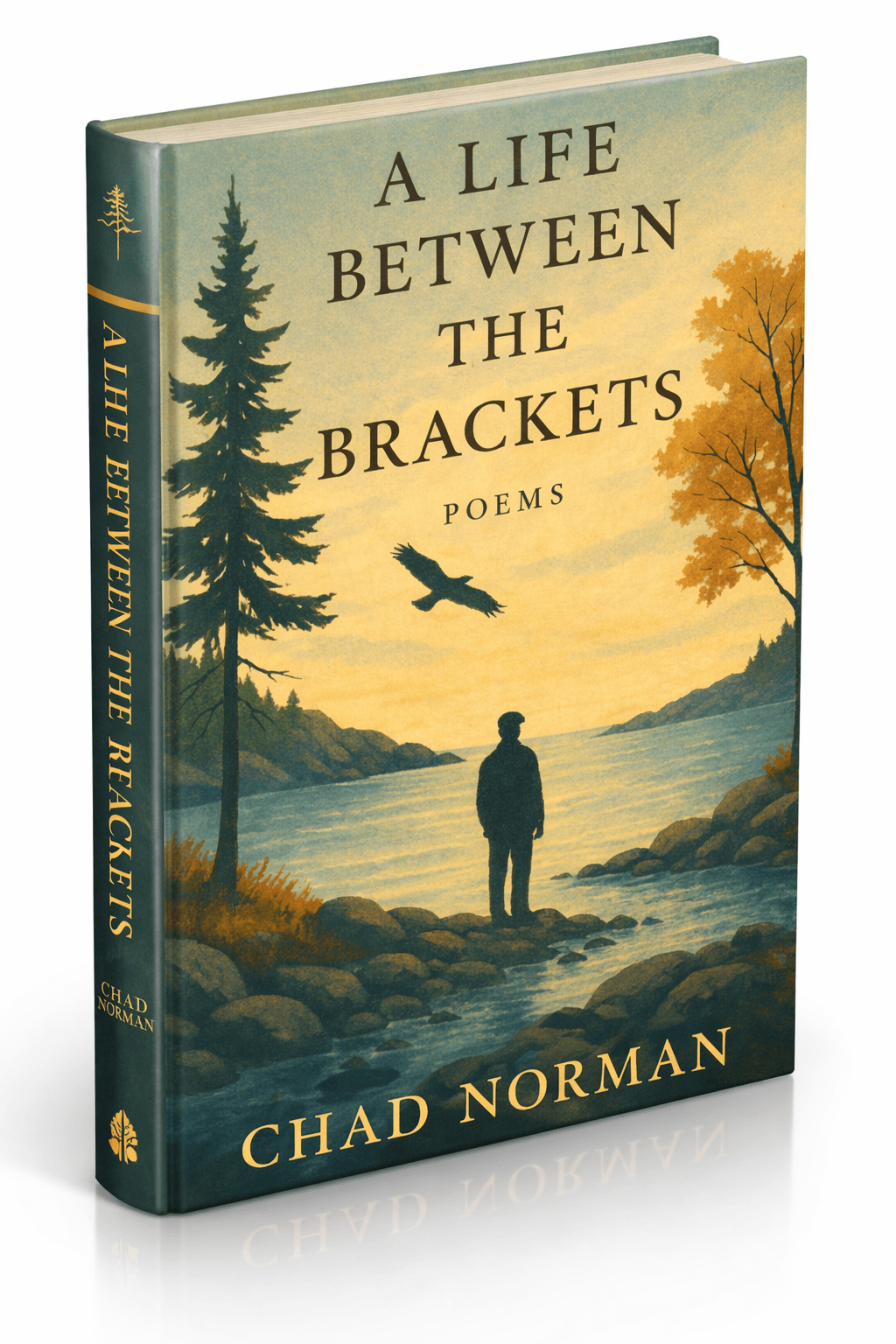
The Language of the Brackets: A Literary Glossary of Chad Norman’s Symbology.
TS
Introduction: The Poet as Observer
Welcome to the internal landscape of Chad Norman as we see it. We're not claiming Chad Norman will agree fully with our analysis, but here it is for what it's worth and we hope some of it resonates with the poet himself!
For the uninitiated, entering this collection is like stepping into a sanctuary where the silence is heavy with meaning. This glossary serves as your "decoder ring" for the recurring motifs that populate Norman’s verse. In this world, symbols are far from mere decoration; they are the "intelligence and secrets" shared by non-human teachers. The poet stations himself at the precarious threshold of the pane, using these recurring images as a bridge between our fractured human existence and the stoic, supportive "intelligence" of the wild. To master this lexicon is to understand how the poet navigates "a life between the brackets," moving from the domestic to the divine. This journey begins at the very edge of the hearth, where the physical boundaries of the home meet the ancient, creaking guidance of the world outside.
Elemental Boundaries: The Window vs. The Forest
Norman frequently positions himself at the boundary of the glass, a vantage point that demands a choice between the safety of observation and the vulnerability of immersion. Stepping away from the safe reflection of the window and into the depth of the hardwoods requires the poet to abandon the role of the passive witness for a state of active, seasonal trust.
The Aviary of Trust: Bird Species as Teachers
In Norman’s symbology, the aviary is a classroom. Birds are not merely subjects of nature; they are instructors of a "feathered tutelage" that models a life unburdened by the "lies of money" or human anxiety.
The Starling: The embodiment of "exclusive talent." Norman elevates the starling as a master of survival that "no human will ever master," noting the specific physical mastery of a fledgling that can "land and rest on a tiny stuffed belly" before returning to the wire.
The Crow: The "trusted follower" and "brother" in observation. Crows represent a sacred bond formed outside the reach of human greed. They are the "followers" who wait for "peanuts and cat-food," offering a connection that cannot be bought or captured.
The Dove: A symbol of "sanity" and quiet trust. Doves remain unworried by the "illegal" nature of feeding wildlife or the boundaries of human law. They represent a state of grace where hunger is helped to an ending without the noise of human conflict.
The Hawk: The "perfection of death." Illustrating the visceral "intelligence of hunger," the hawk reminds us that nature's beauty is surgical. Its presence is marked by "bloodied tiny white feathers impaled on the selected end of a harmless twig," a strike that is as precise as it is necessary.
The Cardinal: The "Morning Activist." Linked to the suffering in Ukraine, the cardinal is a symbol of resilience. In No Other Description Than Disbelief, the "blue beak sorting seeds" at a yellow feeder creates a living flag of hope, representing mothers who endure the weight of "winter’s invasion."
These feathered teachers offer a specific type of "intelligence", one rooted in immediate survival and seasonal mystery, that stands in stark contrast to the misanthropic fear of the human world.
The Political and the Sacred: Historical Symbolism
Norman weaves the rot of contemporary history and the weight of ancient motifs into his observations, grounding the ethereal in the grit of human tragedy.
The White Poppy: Featured in "Woman Sitting in a Chair Wearing a White Poppy," this is the symbol of Peace at the "border of unknowing." It represents the quiet, seated endurance of women in Syria and Ukraine who must hold the future together while male "leaders" fail as both men and protectors.
The Crown of Thorns: In the critique of Bosch’s Another White Christ, the thorns are a symbol of human-imposed suffering. Norman uses this image to expose the "shysters" and "pointy-nosed Pharisees" who attempt to encase the Messiah in devious human motivations, contrasting their greed with the "future promised by the Father."
By invoking these heavy human histories, the poet highlights the urgent necessity of returning to the "natural" truth found only in the unpolluted wild.
Conceptual Pillars: Trust and Intelligence
To truly "grok" Norman’s landscape, one must understand how he redefines these two pillars of the human experience.
Key Concepts
Intelligence: In the human realm, intelligence is often "the cause of fear" and "misanthropic ways," leading to the destruction of habitats. In the natural world, it is the "intelligence and secrets" shared by non-human teachers that provide the only viable instructions for "how to live this life."
Trust: An "annual gift" or "seasonal mystery" that cannot be compelled. It is earned by the "Clapping Man" through the rejection of "human limitations" and the practice of quiet presence. It is the "safety and mystery" offered by the "shelter tree."
These concepts serve as the vital tools that allow the poet to exist "between the brackets," navigating a world that is simultaneously broken by man and mended by the forest.
The Industrial Shadow: Symbols of Human Failure
Contrasting the purity of the aviary are the "pollutants of the spirit" found on "Industrial Ave," representing the ways humanity poisons the very habitat it depends upon.
Pollutants of the Spirit Checklist:
The Leash & The Cell-phone: Symbols of modern "slavery." They represent a betrayal of companionship, where men "cling" to devices and ignore their "best friends," failing to participate in the "escape" of the walk.
The Nut and the Bolt: A "thwarted relationship." The "shiny unused nut" found in a warehouse represents the loss of industry and the "essential dreams" of workers. It is a symbol of a rare connection that will "never know a bolt" and the threads it was meant to wind through.
Discarded Masks and Gloves: Symbols of the "tyrant" pandemic. These represent human cruelty through negligence; the "rubber fingers" left on the grass eventually trap other living beings, polluting the planet’s health while humans seek only their own safety.
These symbols of industrial rot serve as a stark warning against prioritising "the lies of money" over the sanctity of the soil.
Learning to Settle Down
Ultimately, the symbology within this collection is a map for "how to live this life." By defining the threshold of the window and listening to the "feathered tutelage" of the birds, the reader learns to navigate a world fractured by the greed of corporations and the failures of history.
The poet returns to these images; the "Window," the "Parental Forest," and the "unworried birds" because they are the only entities he finds to be "unquestionably supportive." Unlike the conditional loyalty of human systems or the "grab for money" that ends brotherhoods, nature offers an "annual trust" that persists regardless of our presence. May your journey through these poems be a "seasonal migrant's" flight, free to fly over unnoticed borders and into the "miracle of return."
©The ShadowScript Team, April 2026.
*Chad's book is available on Amazon