Book Review: 'More Than The Match'
TS
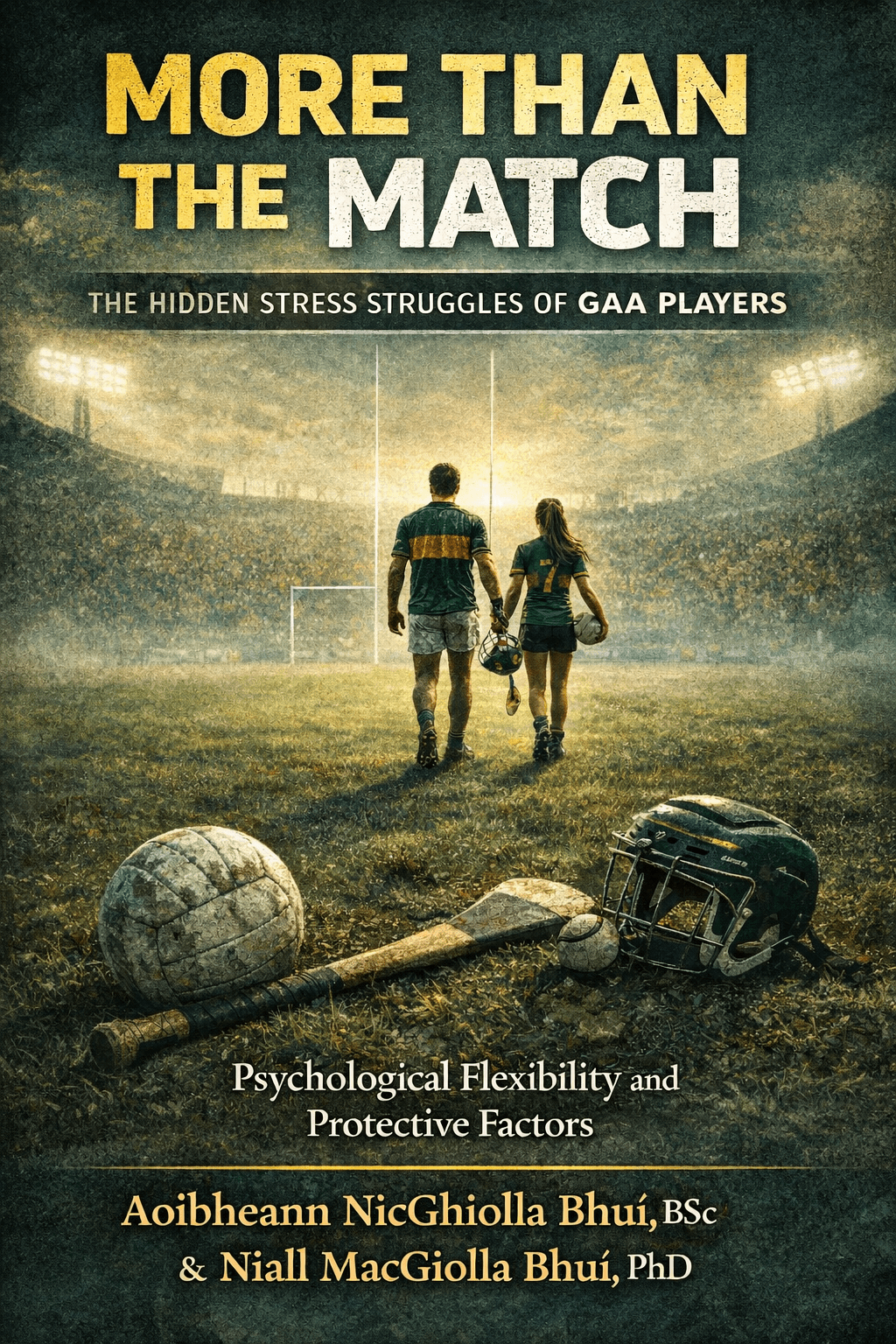
Book Review: 'More Than The Match: The Hidden Stress Struggles of GAA Players' by Aoibheann NicGhiolla Bhuí and Niall MacGiolla Bhuí is a timely and important examination of mental health and psychological well-being among Gaelic Athletic Association athletes. The book combines empirical research with compelling narrative vignettes to illuminate an often-overlooked dimension of elite amateur sport: the psychological toll of competing at high levels while balancing work, education, and personal commitments.
The authors excel at making psychological research deeply relatable. The opening vignettes, "Tuesday Night Drama," "The Alarm," "The Stadium," and "Injury", provide powerful snapshots of athlete experience that ground the book's research findings in lived reality. These narratives are not merely decorative; they serve as a bridge between academic content and the reader's empathy, making abstract concepts like "perceived stress" and "psychological flexibility" feel urgent and immediate.
The study draws on a sample of 100 GAA athletes across elite and sub-elite levels, examining the relationship between psychological flexibility and perceived stress. The finding that players with greater psychological flexibility reported lower stress levels offers a clear, actionable insight. More importantly, the authors acknowledge this discovery does not suggest that stress can or should be eliminated from sport; rather, how athletes relate to pressure matters as much as the pressure itself.
The book demonstrates strong sensitivity to the unique context of Irish sport. The historical grounding, including references to the 1918 ban on Gaelic games and their resurrection despite political oppression, connects current mental health challenges to the GAA's broader cultural identity. This contextual awareness enriches the argument that psychological resilience has deep roots in GAA tradition, even as the nature of contemporary pressures has fundamentally shifted.
While overall stress levels did not differ significantly between male and female players, the study identified important differences in types of stressors: male players more frequently cited time management challenges, while female players reported greater stress from academic demands and interactions with management. This nuanced finding resists simplistic gender narratives and points toward specific, targeted interventions.
The book tackles several structural problems within the GAA. The finding that intercounty players dedicate 25-30 hours per week to training, comparable to elite Australian athletes despite being ostensibly amateur, highlights a critical mismatch between the GAA's amateur status and its actual demands. The authors also note that elite male players receive four times more government funding than female players, a disparity that directly influences stress levels and dropout rates.
The authors candidly acknowledge that their sample was skewed toward female participants (69 females to 30 males), reflecting broader stigma around male mental health in Ireland. While this transparency is commendable, it means gender comparisons require cautious interpretation. A more balanced sample in future research would strengthen claims about gendered stress experiences. The study's cross-sectional design limits the ability to examine how stress fluctuates across a season or how individual trajectories unfold over time. While the authors explain why longitudinal research is difficult to implement with GAA athletes (who compete across multiple teams), this remains a meaningful constraint for understanding the dynamic nature of athlete stress.
The book's strongest contribution may be its practical implications. The authors recommend targeted welfare workshops for coaches and coordinators, greater awareness of psychological flexibility as a trainable skill, and better alignment of championship schedules with academic periods. These suggestions move beyond abstract psychology into concrete institutional change. The emphasis on developing psychological flexibility, rather than simply eliminating stress, aligns with contemporary sport psychology while remaining accessible to practitioners unfamiliar with technical jargon.
More Than The Match succeeds in its central mission: drawing attention to the hidden psychological struggles of GAA athletes and providing evidence-based guidance for intervention. The book balances rigor with readability, research with narrative, and individual agency with systemic critique. Its key finding, that psychological flexibility mediates the relationship between stress and well-being, is neither revolutionary nor surprising, yet its application to the GAA context is novel and urgently needed.
The book will appeal to GAA stakeholders, sports psychologists, coaches, athletes, and anyone interested in the intersection of sport, mental health, and cultural identity. Most importantly, it offers validation to athletes who struggle silently, reminding them that their psychological load is real, measurable, and deserving of institutional support. For a growing field of sport psychology research in Ireland, 'More Than The Match' represents an important step forward.
-Julie Hickey, Book Reviewer, August 2026.