Hugo Simberg, the Grim Reaper and the Irish


It has often occurred to me there is something profoundly un-Irish about the modern imagination of death. We have inherited a figure in a black cloak carrying a sharpened scythe, arriving only to sever life from the living. Death is abrupt. Violent. A thief in the night. But that was never entirely our story. And it still is not so.
Before Christianity wrapped Ireland in heaven and hell, our ancestors lived beside death rather than against it and this is a profound difference. Indeed, I've just co-edited a book of Irish phrases titled 'Mar a Deirtear' that speak to such linguistic delights.
For centuries, the veil between worlds was thin. The dead were not gone; they lingered in place names, in fairy forts, in hawthorn trees that no sensible farmer would dare cut (we have one in our back garden I am fearful to cut even now!). At Samhain, the boundaries dissolved entirely. Fires were lit not simply to keep evil away, but to welcome those who had gone before. Death was not an ending so much as a crossing.
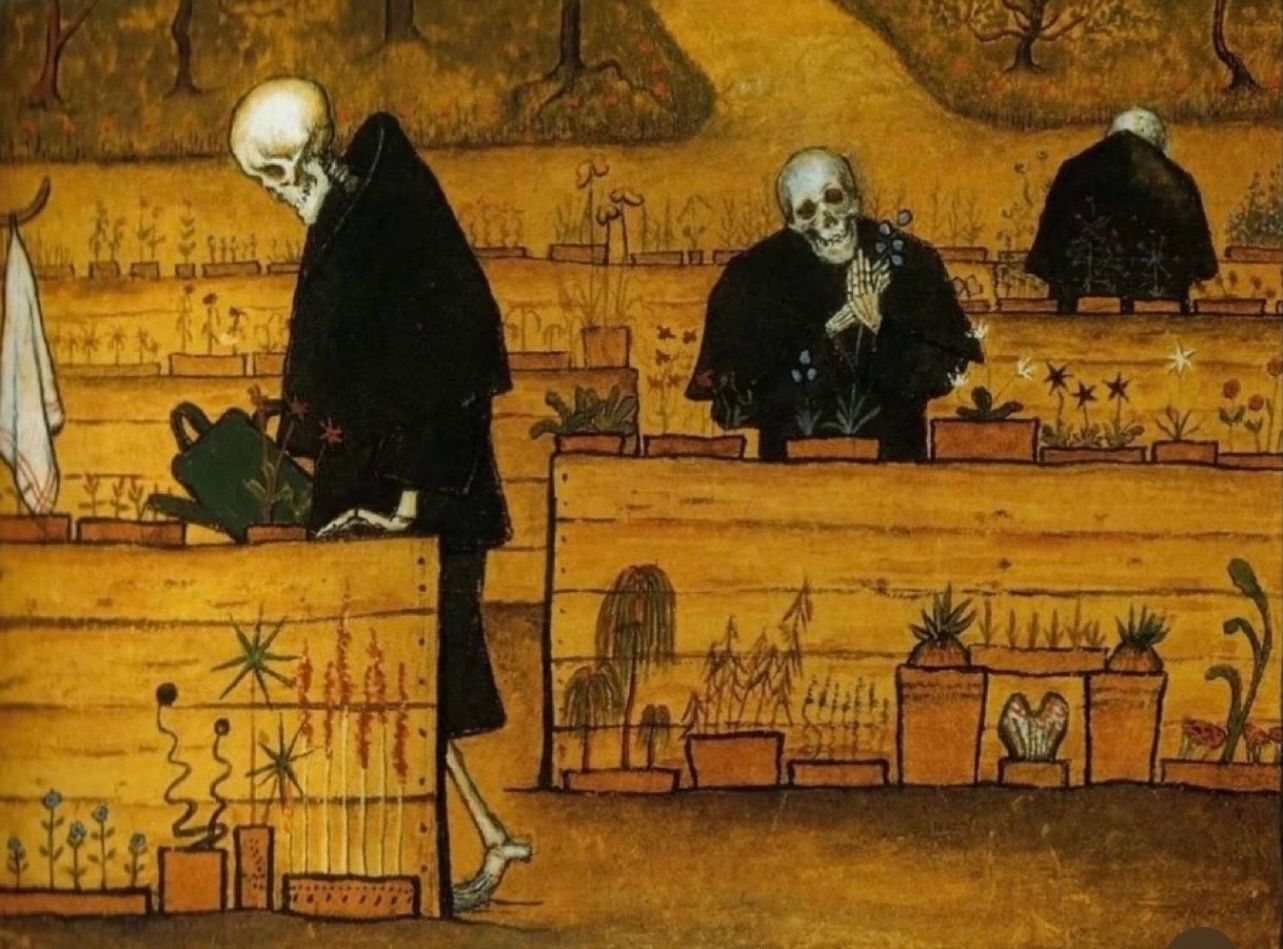
So, it is perhaps for that reason that Hugo Simberg's (1873-1917) painting feels strangely familiar to me, despite emerging from Finland rather than Ireland. It is, quite simply, breathtaking in its original take on life and death.
His reapers do not harvest souls. They cultivate life. Bent over flowerbeds with watering cans and patient hands, they tend fragile things with the quiet concentration of old gardeners. There is no menace in them. No urgency. No cruelty. They neither pursue nor threaten. They simply care. It overturns centuries of iconography in a single image. Wow! Perhaps death is not the executioner we all imagined, but the keeper of an entirely different garden for us all. That's comforting.
Irish folklore offers echoes of this gentler understanding. The Bean Sí, so often mistranslated as a murderous omen, does not kill. Instead, she mourns and her cry announces that the natural order is unfolding. She is less executioner than witness. Likewise, Donn, the ancient god associated with the dead, gathers souls not for punishment, but to the House of Donn, where journeys continue beyond mortal sight. Even the sídhe, the hollow hills beneath which the Otherworld rests, are described not as places of terror, but of abundance, youth and perpetual spring. The dead, in Irish thought, were rarely imagined as extinguished. They had simply changed address.
Simberg seems to understand something similar. Every gardener knows that pruning is not destruction and that seeds disappear beneath dark soil before they eventually become forests. Autumn strips branches bare only so spring can begin its patient work again. Decay is not the opposite of life; it is one of life's oldest collaborators.
Perhaps that is why the reapers wear black. Not because they belong to death, but because they understand its solemnity. Anyone entrusted with tending the threshold between worlds would surely carry themselves with quiet dignity. There is no triumph in their work. No delight in endings. Only care.
It is a startling inversion. What if death kneels beside us more often than it stands over us? What if the hand we fear is, in truth, the hand that gently transplants? Anyone who lives with a gardener (As I do) knows the affection with which they tend their grass, plants, shrubs and trees.
Our ancestors might not have found that idea particularly strange. They buried their loved ones facing landscapes they knew, believing that the relationship between the living and the dead endured. Holy wells became places where both worlds almost touched. Ancient yew trees grew in churchyards because they outlived generations, their roots drinking from the same earth that received the departed. Time itself seemed circular rather than linear. Nothing truly vanished. Everything returned.
I feel there is a humility in Simberg's painting that modern culture often lacks. We speak of losing the battle against death, as though mortality were a military defeat rather than the oldest rhythm in nature. We sanitise it, postpone conversations about it, hide it behind hospital curtains and polished coffins.
Yet every Irish field tells another story. Grass grows from the soil enriched by what came before. Stone walls stand because countless unnamed hands laid them. The landscape itself is an inheritance from the dead.
Perhaps they have been gardening all along. And, the older I get, the more I find that thought oddly comforting. Not because it softens grief. I'm well aware nothing truly can, but because it restores purpose to what often feels senseless. If there truly is another garden beyond our seeing, perhaps it requires patient keepers and gardners. Perhaps every ending is also an act of beloved cultivation. Perhaps the hands we dread are not waiting to reap us in violence, but to tend us with the same quiet care that these skeletal gardeners offer to their flowers.
In a globalised, postmodern world, It is a thoroughly pagan thought. And a rebellious one. And, I suspect, an ancient Irish one too that our ancestors would appreciate.
© Niall MacGiolla Bhuí, PhD (July 2026).